Free Inquiry 4: The effectiveness of app-based learning
In a 16-week study comparing the effectiveness of language learning with Duolingo vs. in a classroom, Gonzalez-Fernandez and De la Viña found that “overall […] app-based learning can support certain aspects of L2 development, particularly receptive grammar and vocabulary knowledge, while classroom-based
instruction is more beneficial for developing listening skills” (2025). The article also notes that while language learning with apps has generally been deemed effective for learning grammar and vocabulary, the development of oral and listening skills is less evident (Gonzalez-Fernandez & De la Viña, 2025). The participants in the study were all native Spanish speakers learning English at an A2 level. Their study outlines that the classroom learners “used English as the main language of instruction, emphasized L2 use and social interaction, and discouraged L1 use” (Gonzalez-Fernandez & De la Viña, 2025). While Duolingo’s lessons generally aim to teach you vocabulary and essential phrases using a combination of written, multiple-choice, and listening modes, the classroom model focuses on person-to-person interaction in the second language. These findings are generally consistent with my experience of language learning. When learning Spanish, I developed a strong vocabulary base using apps and online learning resources. Still, I did not truly develop my listening comprehension and oral fluency until I had conversations with others and avoided translating from English. Duolingo is a fun and motivating way to get started with your language learning journey, and certainly it is possible to learn a language with Duolingo, but in isolation, it will likely not build conversational fluency. As a French-immersion teacher candidate, this fascinates me because it demonstrates that both online and in-class learning play a role in language development.
Below is a sample from the listening pre-test :
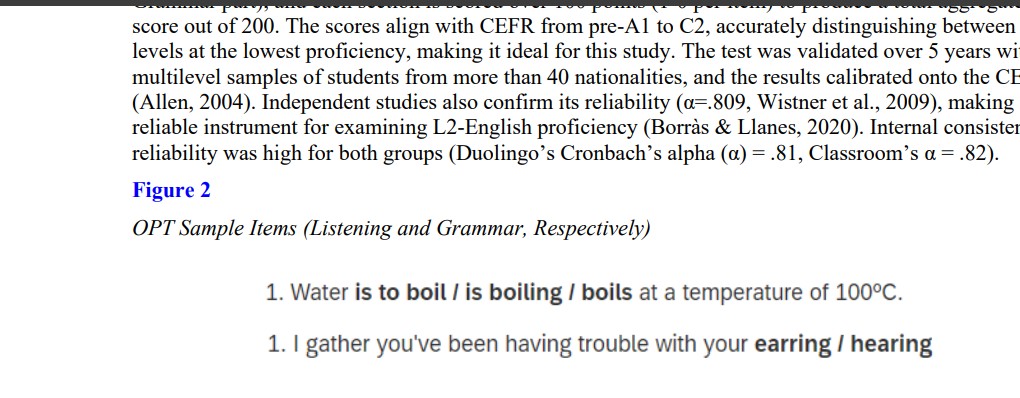
This listening sample provides learners with similar words, which, if they had only seen them written, would be difficult to distinguish. For instance, if we take into account that in Spanish they do not pronounce the “H” sound, native Spanish speakers would likely have a hard time distinguishing the correct answer by listening if they had only seen the word “hearing” written and never spoken. This demonstrates the value in exposing yourself to spoken language in context, whether that be in movies and videos or in person. Duolingo does provide listening samples, but they generally only pronounce one word or a short phrase that you have previously learned; they do not put the words in larger phrases or out of your memorized context.
The above screen recording is an example of a listening exercise in my Duolingo course. As you can see, it only asks you to identify one missing word in a sentence. I do know from experience that in the harder levels, they sometimes ask you to identify entire phrases, but again, only from sample phrases you have already practiced extensively and memorized.
My main takeaway from this article is that Duolingo and language learning apps have their place, but they do not teach true fluency because they do not expose you to real conversation or ask you to identify vocabulary outside of the rehearsed context.
Bibliography:
González-Fernández, B. & de la Viña, I. (2025). The effectiveness of app-based and classroom-based instruction on L2 learning and motivation. Language Learning & Technology, 29(1), 1–18. https://doi.org/10.64152/10125/73656