Reflection on Gamification and Game-Based Learning
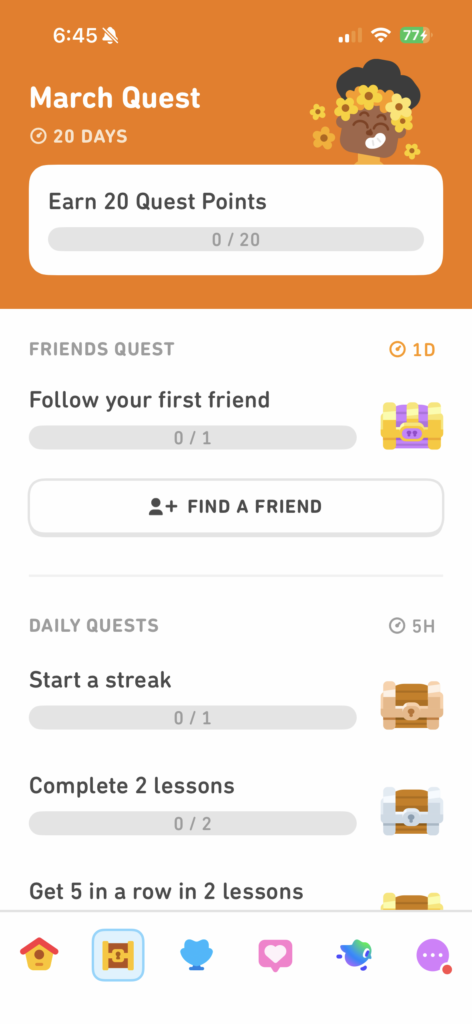
Game-based learning and gamification can be highly effective in increasing engagement and helping students understand complex concepts in an engaging way. That being said, not all gamification is equally effective. With my inquiry project, I have come to realize that many language learning apps are game-based, but end up over-emphasizing the game aspect at the cost of meaningful learning. For example, Duolingo gives learners lives and points, and you collect gems for completing practice sessions. That being said, students are rewarded more for speed than genuine learning. If learners get too many questions wrong, then they cannot continue to practice for that day. It is also my understanding that you receive more points if you answer questions faster. Students must submit correct answers to get points and earn the right to continue practicing, but there is no way for them to go back and review the words and phrases in an untimed practice session or word bank. If you struggle with a word, there is no way to go back to practice it without completing an entire practice session. I understand that the game-based aspect engages learners and that points and streaks keep learners motivated, but if they are punished for wrong answers with less practice time, that seems counter-intuitive. I think there is a way for a language learning app to have points and timed test sections, while also allowing for review at your own pace and without punishing incorrect answers. I can absolutely see the merit in the game element; my sister has a 500-day streak on Duolingo and is fully engaged in learning Spanish. However, after 500 days of daily practice, she still cannot hold a conversation and may not understand learned vocabulary outside of the context that she practiced it. I do not think that higher engagement necessarily leads to better learning. It is certain that she knows more Spanish than if she did not practice at all, so it certainly has taught her something, but if she committed to daily conversations with myself or my Mexican partner, she would probably learn more quickly because she could get things wrong, be gently corrected, and keep practicing. I think the leaderboard and social aspect of Duolingo is a really strong feature that would work well with classes, because you can hold your friends accountable with streaks and have friendly competitions in who practices more and earns the most points. If students are going to learn from a game, then I think it is essential the information they are learning is kept somewhere, whether in a separate document or in a word bank, so that students can go back to that information at any time. Timed tests and challenges can be fun to test already gained knowledge, but does not seem effective in helping you learn something new. I think the quests for gems are really fun and could be a really good way to get through a unit, but I would rather see it structured around proven learning and not simply completing rounds. For instance, instead of “complete 5 lessons and earn this badge,” it could be “complete a 30 minute review session, challenge a friend, and do an audio practice” to earn this badge. This would move it away from a checklist model and force the learner to actively participate.