Discussion 4: AI and the Environment
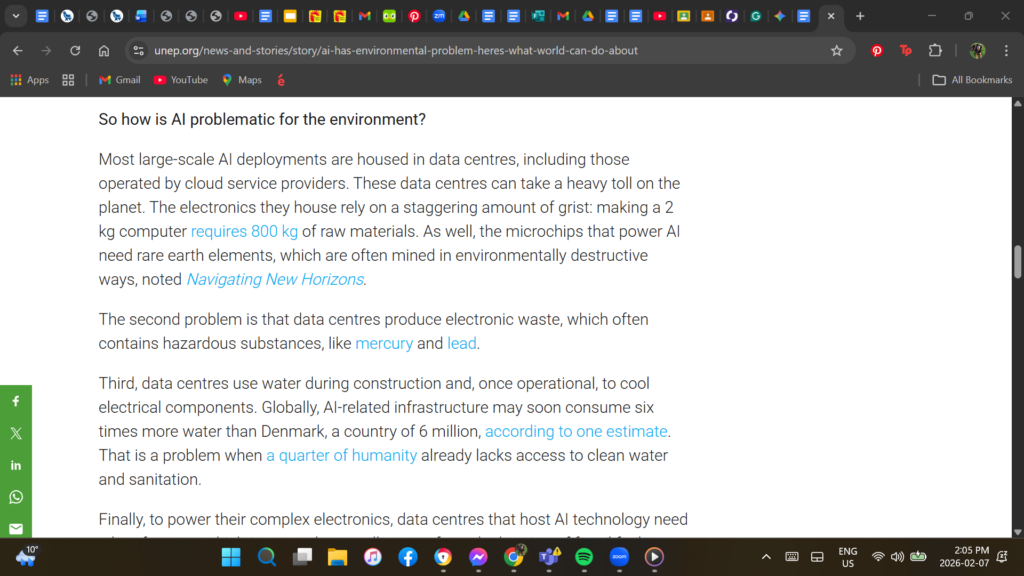
Can we mitigate the environmental damage caused by AI? According to a 2025 article from the United Nations Environment Program, there are still several unknowns about the extent of environmental harm caused by AI, but it is a massive consumer of energy and water. According to the article, it was estimated that by 2026 (now), AI data centers would represent up to “35% of the country’s energy use” (UN, 2025). AI alone is responsible for more than a third of its total energy consumption. They also noted that the data centers require massive amounts of raw materials, often sourced unsustainably, and that, soon, AI-related infrastructure could use more water than all of Denmark (UN, 2025). As for mitigating these risks and preventing them from growing, the UN suggests 5 main factors:
- Countries should establish standardized procedures to measure the impacts of AI.
- Governments can develop regulations that require companies to disclose the direct environmental consequences of AI-based products and services.
- Tech companies can make AI algorithms more efficient, reducing their demand for energy, while recycling water and reusing components where feasible.
- Countries can encourage companies to green their data centers, including by using renewable energy and offsetting their carbon emissions.
- Countries can weave their AI-related policies into their broader environmental regulations
Essentially, the UN suggests it comes down to a combination of finding out the actual extent of the damage caused by AI and policies that ensure transparency and responsibility.
From this article, it seems that there are no tangible solutions to protect our environment from AI. Even if countries and tech companies are measuring the damage and are forthright about the impacts, it will not prevent or stop the damage from continuing. Until AI algorithms are made more efficient (and it seems we still do not know how to do that), AI’s continued growth will likely have detrimental impacts.
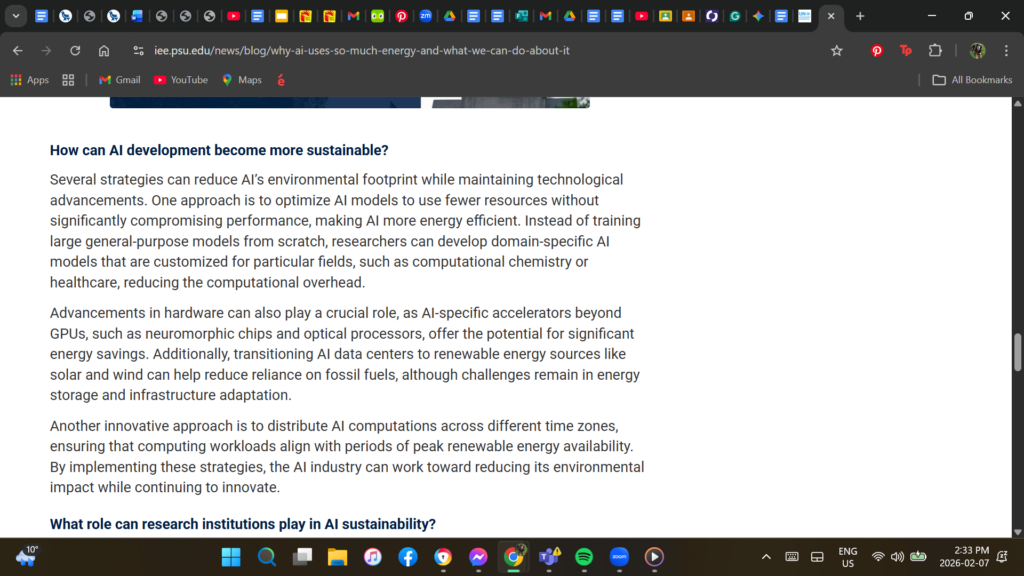
Another article from Penn State agrees that to mitigate the damage caused by AI, we must improve its efficiency: “One approach is to optimize AI models to use fewer resources without significantly compromising performance, making AI more energy efficient” (2025). The article also mentions the possibility of powering AI with renewable energy sources. Real impact, then, relies on technological advancement and political and corporate policy. On an individual level, the only obvious way to mitigate its damage is to avoid its use when or if possible.
Bibliography:
Penn State. (2025). “Why AI uses so much energy — and what we can do about it.” Penn State Institute of Energy and the Environment. https://iee.psu.edu/news/blog/why-ai-uses-so-much-energy-and-what-we-can-do-about-it
United Nations. (2025). “AI has an environmental problem. Here’s what the world can do about that.” United Nations Environment Programme. https://www.unep.org/news-and-stories/story/ai-has-environmental-problem-heres-what-world-can-do-about